
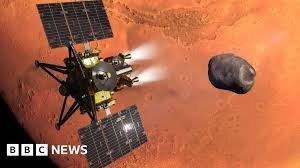
A Giant Leap for Planetary Science: The Journey to Phobos Begins
The eyes of the scientific community are turned toward the stars as a groundbreaking spacecraft launches today from Japan. This isn’t just another trip into the void; the Japan Aerospace Exploration Agency (JAXA) is embarking on the Mars Moons Exploration (MMX) mission, a daring quest to visit Phobos, one of Mars’ two enigmatic moons.
The goal is as ambitious as it is precise: land on Phobos, collect a sample of “moondust,” and bring it back to Earth. If successful, this will mark the first time in history that material from the Martian system—either the planet or its moons—has been returned for laboratory analysis on our home planet.
The Mystery of the “Space Potatoes”
Mars is orbited by two tiny, irregularly shaped moons: Phobos and Deimos. Described by scientists as looking like “space potatoes,” Phobos is roughly 20km across, while Deimos is even smaller at about 10km. But their odd shapes hide a deeper cosmic mystery: Where did they come from?
There are two leading theories that the MMX mission aims to settle:
- The Impact Theory: A massive space rock collided with Mars early in its history, and the moons formed from the resulting debris.
- The Capture Theory: Phobos and Deimos were wandering asteroids from the outer Solar System that were snagged by the Red Planet’s gravitational pull.
Engineering the Impossible: Landing on a Low-Gravity Moon
Arriving at Phobos in August 2027 will be the easy part. The real challenge lies in the landing. Because Phobos is so small, it has very little gravity of its own. However, it sits precariously close to the massive gravitational pull of Mars.
As Prof. Sara Russell from the Natural History Museum explains, this gravitational tug-of-war makes landing a rover an incredibly complex feat. The MMX spacecraft will first deploy a small scout rover to analyze the terrain and identify a safe landing site before the main craft touches down to deploy its robotic arm.
Why 10 Grams of Dust Change Everything
The mission aims to return a tiny amount of material—just 10 grams. While it sounds insignificant, in the world of planetary science, every grain counts. By analyzing the chemical and mineral composition of this dust, scientists can immediately determine if the moon is an asteroid or a piece of Mars.
Moreover, there is a thrilling “bonus” possibility. Because Phobos is so close to Mars, debris from Martian surface impacts may have landed on the moon. This means the sample returning to Earth in 2031 could contain actual pieces of Mars, providing a pristine look at the Red Planet’s history.
A Global Race for Martian Samples
The MMX mission arrives at a critical time for space exploration. While NASA’s Perseverance rover has been caching samples on Mars since 2021, the mission to bring them home (Mars Sample Return) has faced significant funding hurdles in the US Congress. Meanwhile, China is planning its own sampling mission scheduled for 2028.
Unlike Martian meteorites that fall to Earth naturally—which often become contaminated by our atmosphere and water—the MMX samples will be sealed in a capsule and delivered directly to the Woomera desert of South Australia in 2031, remaining pristine and pure.
As the spacecraft launches today, we move one step closer to solving the puzzles of our solar system and understanding the violent, fascinating history of the Red Planet and its mysterious companions.