
A Giant Leap for Paleontology: Uncovering the T. Rex’s Gait
For decades, the Tyrannosaurus rex has reigned as the most iconic predator in popular culture. We have seen its massive skeletons in museums and its roar in movies, but a new discovery is allowing scientists to finally “step into its shoes.”
Researchers have recently identified what is believed to be the first set of footprints—a trackway—left behind by an adult T. rex. This discovery, published in the Journal of Vertebrate Paleontology, provides a rare glimpse into the actual movement of the king of dinosaurs.
The Discovery in the Hell Creek Formation
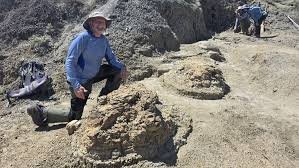
The breakthrough happened in the rugged terrain of the Hell Creek Formation in North Dakota. Kent Hups, a high school teacher and passionate paleontologist, stumbled upon the tracks while fossil hunting along a steep incline. Unlike traditional fossils buried deep underground, these tracks stood out because the sediment that filled them eroded more slowly than the surrounding rock.
Key details of the find include:
- n
- Size: Individual footprints measuring approximately 80 centimeters across.
- Structure: Distinct three-toed shapes characteristic of large theropods.
- Trackway Length: A 7-meter-long sequence of steps.
- Age: Estimated to be roughly 66.5 million years old.
How Fast Did a T. Rex Actually Walk?
While a single footprint tells us about the size of the animal, a trackway reveals its behavior. By analyzing the stride length and body size, paleontologists estimated the predator’s speed at about 1.6 meters per second.
To put that into perspective, this is roughly equivalent to a brisk human walking pace. While the T. rex is often depicted as a sprinting monster, this evidence suggests that during its daily routines, it moved with a steady, purposeful amble.
Why This Discovery Matters
According to Peter Falkingham, a paleontologist at Liverpool John Moores University, the difference between a single print and a trackway is immense. While isolated prints exist, a sequence of steps allows scientists to study foot placement and weight distribution.
Understanding how an adult T. rex walked helps researchers differentiate between the movements of juveniles and adults, much like how human toddlers walk differently than adults. This discovery adds a crucial layer of biological data to our understanding of Tyrannosaurus rex anatomy and behavior.
What’s Next for the North Dakota Site?
The exploration isn’t over yet. Evidence suggests that a fifth footprint may still be hidden within the hillside, waiting for natural erosion to reveal it. Paleontologists are eagerly waiting for Mother Nature to uncover more of this prehistoric path, potentially providing even more data on the gait of the most famous dinosaur to ever walk the Earth.



