
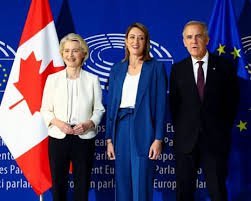
A Strategic Pivot: Canada’s Bold Move Toward the European Union
In a move that could redefine North American diplomacy, Canada has been invited to become the first-ever “associate member” of the European Union (EU). This unprecedented offer, extended by European Commission President Ursula von der Leyen, signals a profound shift in how Canada views its place in the global order.
Speaking at the European Parliament in Strasbourg, von der Leyen emphasized that Canada and the EU “see the world with the same eyes,” citing a deep alignment in democratic values and a shared urgency to tackle global crises, ranging from the climate breakdown to the complexities of Artificial Intelligence and the conflict in Ukraine.
The Mark Carney Influence: Strength and Strategy
At the center of this diplomatic evolution is Mark Carney. His approach to international relations has resonated strongly with European leaders, particularly his refusal to let Canada be “subjugated” in trade negotiations. In an era of volatility, Carney has advocated for a “unique alliance” with the EU as a strategic hedge against heavy dependence on U.S. trade.
European MEPs have praised Carney’s assertive stance. While some European nations have traditionally played a more conciliatory role in trade disputes, Carney’s willingness to implement retaliatory tariffs and stand firm has earned him respect in Brussels. As Spanish MEP Javier Moreno Sánchez noted, “Trump respects people who are strong,” suggesting that Carney’s leadership style is exactly what is needed to navigate current geopolitical tensions.
Building an “Alliance for the Future”
The proposed associate membership is more than just a symbolic gesture; it is an economic and security blueprint. The existing trade agreements are set to be upgraded into a comprehensive alliance focusing on several key pillars:
- n
- Tech & Innovation: A dedicated tech alliance focusing on AI, quantum computing, and cybersecurity.
- Energy Security: Joint ventures in critical minerals and battery production to reduce reliance on autocratic regimes.
- Defense & Geopolitics: Integration of defense industrial bases and a shared strategic focus on the Arctic.
- Common Prosperity: Creating an economic security space that protects shared democratic interests.
Challenges and the Road Ahead
Despite the enthusiasm, the path to associate membership is not without hurdles. The EU has historically been rigid about its “four freedoms” (goods, services, people, and capital), and it remains unclear how Canada can be “half in” without full integration into the single market. Furthermore, several EU member states, including France and Italy, have yet to fully ratify the existing EU-Canada trade deal (CETA).
However, geopolitical shifts are pushing the EU toward greater flexibility. Analysts suggest that Canada’s membership might not be traditional but rather a system of “plugging in” to existing frameworks like the European Defence Agency.
Final Thoughts
As Mark Carney continues to champion the idea that “middle powers” must unite to survive a fracturing international order, Canada stands on the precipice of a new era. By diversifying its partnerships and leaning into its European affinities, Canada is not just seeking a trade deal—it is securing its future in an unpredictable world.



