
Donald Trump and the Bold Call for Irish Unity: A Political Game-Changer?
In the volatile and often unpredictable world of Donald Trump, few things are truly off-limits. From unexpected diplomatic pivots to daring policy shifts, the former US president has a knack for stepping directly into political minefields. His latest foray? The deeply sensitive and complex issue of Irish unity.
For years, Trump maintained a cautious distance from the intricacies of Northern Irish politics. While he occasionally mentioned a “merger,” he typically avoided taking a definitive personal stance, acknowledging the complicated relationships at play. However, that restraint vanished during a recent visit to Dublin.
A Sudden Shift in Rhetoric
Sitting alongside Taoiseach (Irish Prime Minister) Micheál Martin, Trump surprised observers by declaring his “full-throated support” for the reunification of Ireland, stating that he would “love to see it” happen. This was not merely a spontaneous comment; evidence suggests the topic was discussed during high-level meetings with the Taoiseach.
Why the sudden change of heart? Political analysts suggest several possible motivations:
- n
- Strategic Diversion: It may have been a calculated move to put his hosts at ease and steer the conversation away from more contentious topics, such as the conflict in Gaza or the fallout from tensions with Iran.
- Voter Outreach: Trump might be eyeing the influential Irish-American voting bloc, seeking to bolster support ahead of critical mid-term elections.
The Reaction: From Disbelief to Dismissal
As expected, the reaction from Unionist politicians and the UK government was swift and critical. Officials characterized the intervention as “unhelpful,” grouping it with other infamous “Trumpisms”—such as his previous suggestions regarding the acquisition of Greenland or the outlandish idea of making Canada the 51st US state.
Despite the attempts to dismiss his comments as mere rhetoric, the conversation surrounding Irish reunification is far from a fantasy. Unlike the Greenland proposal, there is a legal and political framework already in place: the Good Friday Agreement.
Does This Actually Change the Timeline?
While Trump is arguably the most powerful individual in the global political arena, his endorsement does not unilaterally trigger a border poll. The power to initiate such a vote rests solely with the UK government, and the specific criteria for triggering that process remain unclearly defined.
However, for those campaigning for a united Ireland, this endorsement provides a significant psychological momentum. Having a figure of Trump’s stature publicly support the cause adds a layer of international visibility that cannot be ignored.
Golf, Politics, and Pressure
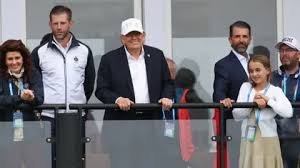
The political drama continued as Trump attended the Irish Open. Surrounded by figures like former DUP MP Ian Paisley—a family friend who attempted to downplay the President’s comments as a “wrong” personal opinion—the atmosphere remained tense. With the Taoiseach also in attendance, the intersection of sport and high-stakes diplomacy ensured that questions about Irish unity remained front and centre.
Whether this was a fleeting comment or a strategic realignment, Donald Trump has once again proven that he is willing to disrupt the status quo, leaving the UK and Ireland to navigate the ripples of his unpredictable diplomacy.



