
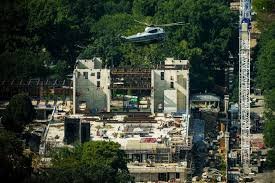
A Legal Victory for the Executive: The White House Ballroom Controversy
In a decisive move that has sent ripples through the political and preservationist communities, the United States Supreme Court has cleared the path for President Donald Trump to move forward with the construction of a massive new ballroom at the White House. This ruling effectively dismisses a legal challenge brought forward by a preservation group aimed at halting the ambitious and controversial project.
The decision, passed with a narrow 5-4 margin, highlights a deep divide within the court. While the conservative majority favored the administration, Chief Justice John Roberts and the court’s three liberal justices stood in dissent, raising concerns about the legality of the construction.
The Legal Nuance: What is “Standing”?
Interestingly, the Supreme Court did not rule on whether the ballroom project itself was lawful. Instead, the eight-page unsigned decision focused on a procedural hurdle known as “standing.” The court concluded that the National Trust for Historic Preservation likely lacked the legal right to challenge the project in the first place.
This technical victory is a major win for the Trump administration, granting the president the necessary time to push the project toward completion while any further litigation continues to simmer in the background.
Ambition, Legacy, and National Security
The proposed ballroom is far from a modest addition. Spanning nearly 90,000 square feet, the project is seen by the president as a cornerstone of his presidential legacy. Beyond the aesthetic and social prestige, the administration has defended the construction on the grounds of national security.
- n
- Advanced Protection: The ballroom is designed to include state-of-the-art security features.
- Defense Capabilities: Trump asserts that these upgrades are essential to protect the White House from potential attacks.
- Scale: The sheer size of the facility aims to accommodate high-level state functions with modern efficiency.
The Dissent: A Warning from Chief Justice Roberts
Despite being part of the court’s conservative wing, Chief Justice John Roberts was vocal in his opposition. In his dissent, Roberts argued that the construction was “likely unlawful,” emphasizing that the White House is not merely another federal building.
“The White House is not just any building,” Roberts wrote, suggesting that the court’s decision ignores the potential infringement on the legislature’s “power of the purse” and its authority to regulate federal property within the District of Columbia.
As the construction crews continue their work, the debate over the balance between executive ambition and historical preservation remains as heated as ever. For more information on how the federal government manages historic sites, you can visit the official White House portal.



