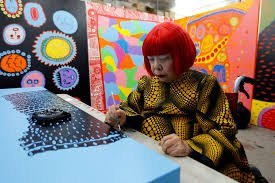
Celebrating the Life of Yayoi Kusama: The Matriarch of Contemporary Art
The art world mourns the loss of a true visionary. Japanese artist Yayoi Kusama, who passed away at the age of 97, leaves behind a legacy that redefined the boundaries of contemporary art. Known globally for her obsessive use of polka dots and her exploration of the infinite, Kusama was more than just a painter; she was an avant-garde powerhouse who paved the way for icons like Andy Warhol and Keith Haring.
From immersive installations to haunting sculptures, her work served as a bridge between mental health struggles and transcendent beauty. For Kusama, art was not just a career—it was a survival mechanism.
The Origin of the Obsession: Turning Hallucinations into Art
Born in 1929 in Matsumoto, Japan, Kusama’s journey began with a struggle for understanding. From a young age, she experienced vivid hallucinations where plants spoke to her and floral patterns danced off tablecloths to cover her entire surroundings. While her family viewed these episodes with confusion and disapproval, Kusama found solace in the brush.
This lifelong battle with her psyche led to her signature style: the repetition of dots and nets. She described this process as “self-obliteration,” a way to lose herself in the vastness of the universe to silence her inner anxiety.
The New York Era: Breaking Barriers and Defying Norms
Encouraged by the legendary Georgia O’Keeffe, Kusama moved to New York City in 1957. In a male-dominated art scene, she carved out a space for herself through sheer willpower and eccentricity.
- n
- Soft Sculptures: She created phallic fabric installations that challenged the norms of the time.
- The Accumulation Concept: Her repetition of objects intrigued a young Andy Warhol, though Kusama later accused him of plagiarizing her concepts of accumulation.
- Activism: She organized “love happenings” in Central Park to protest the Vietnam War, using art as a tool for political awakening.
From a Psychiatric Clinic to Global Superstardom
After years of psychological exhaustion in New York, Kusama returned to Tokyo and voluntarily resided in a psychiatric hospital. Remarkably, she continued to produce art at a breathtaking pace from her studio located right next to the clinic.
By the 1990s, the world finally caught up with her vision. Her Infinity Mirror Rooms became global sensations, offering visitors a glimpse into an eternal, shimmering cosmos. Her collaboration with Louis Vuitton in 2012 cemented her status not only as an artist but as a global brand.
A Legacy That Transcends Time
Yayoi Kusama’s market value mirrored her cultural impact. In 2014, her work White Net No. 28 sold for $7.1 million, making her one of the most successful female artists in history. However, her true success lay in her ability to turn pain into a universal language of wonder.
“When I am old and dying in 200 or 500 years… I would like to continue drawing, and when I am reincarnated, I would like to be born an artist again.”
Today, the work of Japanese artist Yayoi Kusama continues to inspire millions, reminding us that even in the midst of chaos and illness, there is a possibility for infinite beauty.