
The Future is Now: How Climate Change is Paralyzing Global Shipping
For decades, policymakers and economists viewed climate change as a distant threat—a crisis whose heaviest bills would be paid by future generations. However, the reality has shifted abruptly. The “future” has arrived, and it is currently choking the arteries of international trade. While geopolitical tensions often dominate the headlines, a silent environmental disaster is snarling global shipping and destabilizing supply chains across the planet.
The Rhine River: Europe’s Logistics Nightmare
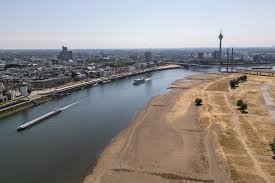
One of Europe’s most critical shipping routes, Germany’s Rhine River, has recently hit record-low water levels. This isn’t just a seasonal fluke; it is a systemic failure driven by rising temperatures. With less snow in the Alps during winter, there is significantly less meltwater to feed the river during the warmer months.
The economic repercussions are immediate and severe:
- n
- Reduced Capacity: Cargo carriers have been forced to slash shipments to as little as one-fifth of their normal capacity.
- GDP Impact: According to estimates from ING, the halt in traffic on the Rhine could lower Germany’s GDP by 0.3 percentage points this year.
- Regional Decline: Insurer Allianz suggests that extreme heat waves across Europe could cut the continent’s overall GDP by a similar margin, with countries like France, Italy, and Spain facing even steeper losses by 2030.
The Panama Canal: A Bottleneck of Record Proportions
The crisis isn’t limited to Europe. In the Americas, the Panama Canal—a cornerstone of maritime shipping—is facing a dual threat: falling water levels and an influx of diverted traffic. The ongoing El Niño event, the strongest in 76 years, has decimated rainfall patterns, pushing the canal’s infrastructure to its absolute operational limits.
The result? A bidding war for survival. Transit slots in the canal’s most used locks are being auctioned off at prices up to 16 times higher than last year’s average. This surge in cost trickles down to every consumer, increasing the price of goods worldwide.
Beyond Logistics: The Energy Domino Effect
The impact of water scarcity extends beyond the movement of goods. In Hungary and Romania, record-low levels of the Danube River have forced nuclear plants to cut output because there isn’t enough water to cool the reactors. In France, warming oceans have led to jellyfish swarms that clog seawater pumping stations, knocking nuclear reactors offline.
These events prove that the intersection of climate change and shipping infrastructure is not just a logistics problem—it is an energy and national security crisis.
Debunking the “Gradual Approach” Myth
Some economists, including Nobel laureate William Nordhaus, previously argued that a gradual approach to decarbonization would be more economically viable, allowing us to grow wealthier before tackling the climate crisis. But this theory ignored the ballooning immediate costs.
We are no longer waiting for the bill; we are paying it through:
- Skyrocketing insurance rates due to wildfires and hurricanes.
- Loss of labor productivity during extreme heat waves.
- Increased fertilizer costs as maritime traffic grinds to a halt in contested zones like the Strait of Hormuz.
Conclusion: Navigating an Unnavigable World
The current state of global shipping serves as a warning. When we ignore environmental limits, the economy doesn’t just slow down—it breaks. To avoid a world that is literally unnavigable, there must be a shift from denial to aggressive adaptation and decarbonization. The cost of inaction is no longer a theoretical projection; it is a line item on today’s balance sheet.
To learn more about the global impact of trade disruptions, you can explore the World Bank’s Trade reports or study the latest climate data from the IPCC.



