
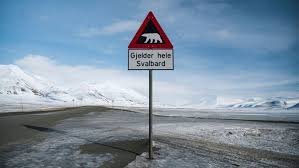
The Cost of a Rude Awakening: Massive Fine for Disturbing a Polar Bear in Svalbard
In the pristine and frozen wilderness of Norway’s Svalbard archipelago, the silence of the Arctic is more than just a characteristic of the landscape—it is a legal requirement for the protection of its most iconic inhabitant: the polar bear.
Recently, one individual discovered that disrupting this silence comes with a heavy price tag. The Governor of Svalbard announced that a person has been fined 50,000 kroner (approximately $5,300 USD) after intentionally waking a slumbering polar bear using a ship’s foghorn.
A Noise That Cost Thousands
The incident took place in August aboard a vessel navigating a fjord in northern Svalbard, a remote region situated between mainland Norway and the North Pole. While sailing, the occupants spotted a polar bear resting on land. In a move deemed reckless and intentional, a person on board triggered the vessel’s low-pitched foghorn—a tool strictly reserved for maritime warnings—forcing the bear to wake up and relocate.
Authorities were quick to act, emphasizing that such behaviour is a direct violation of environmental protection laws. This isn’t the first time tourists have faced penalties in the region; earlier this year, another individual was fined for attempting to approach a walrus, proving that the Governor’s office is maintaining a zero-tolerance policy toward wildlife harassment.
Why Waking a Polar Bear is Dangerous for the Animal
While it might seem like a harmless prank to some, disturbing a polar bear during the summer months can be a matter of survival. During the ice-free season, these apex predators have limited access to their primary food source: fat-rich seals.
According to Geoff York, Vice President of Research and Policy at Polar Bears International, these animals often enter a state of reduced activity to conserve energy.
“Bears resting in the summer ice-free season… often choose to just wait out the lean times with very long naps and very little movement,” York explained. “Disturbing bears during this time… may be more significant for their survival… by causing them to burn calories unnecessarily.”
Strict Regulations: The Rules of the Arctic
To ensure the survival of the estimated 3,000 polar bears in the Svalbard and Barents Sea region, the Norwegian government enforces strict proximity laws. Since 1973, the species has been protected by international law, and hunting them is strictly forbidden.
Visitors to the archipelago must adhere to the following safety and conservation zones:
- n
- July to February: A minimum distance of 300 metres (984 feet) must be maintained.
- March to June (Mating Season): The no-go zone increases to 500 metres (1,640 feet) to avoid disturbing breeding pairs.
Preserving the Apex Predator
The Arctic ecosystem is fragile, and the pressure of melting sea ice is already challenging the polar bear’s way of life. By enforcing strict fines and laws, Svalbard aims to deter irresponsible tourism and ensure that the “Kings of the Arctic” can rest and hunt undisturbed.
For those planning a trip to the North, the message is clear: admire the wildlife from a distance, respect the silence, and remember that in the Arctic, the bears always come first.



