
The Sky on Fire: Ukraine’s Massive Drone Onslaught Against Russia
In what is being described as one of the most significant aerial offensives since the beginning of the year, Russia has reported the interception of over 800 Ukrainian drones in a single overnight operation. The scale of the attack underscores a strategic shift in the conflict, as Ukraine increasingly penetrates deep into Russian territory to strike critical infrastructure.
While Russian authorities claim a high interception rate, the impact has been felt across multiple regions, resulting in at least six confirmed deaths and significant structural damage to industrial hubs.
Targeting the “Amazon of Russia”: The Wildberries Strikes
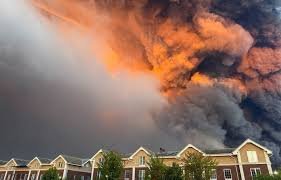
One of the most striking aspects of this offensive was the repeated targeting of Wildberries, the e-commerce giant often referred to as the Russian equivalent of Amazon. A massive 250,000-square-meter warehouse in the Moscow region was engulfed in flames, as confirmed by geolocated footage.
According to reports from Reuters, Ukraine has strategically targeted seven of the ten largest Wildberries logistics centers. The military reasoning behind these strikes is clear: Kyiv claims that Wildberries is being used to handle essential supplies for the Russian military, making these commercial hubs legitimate strategic targets.
Strategic Blows to the Defense-Industrial Complex
The aerial war extended far beyond Moscow. In the Rostov region, a critical strike hit a defense-industrial enterprise specializing in the production of solid rocket propellant. This material is vital for a variety of Russian weapon systems, meaning the attack had direct implications for Russia’s munitions capabilities.
Key highlights of the overnight attacks:
- Moscow Region: 187 drones neutralized by air defense and electronic warfare units.
- Rostov Region: Five fatalities reported following the strike on a propellant plant.
- Maritime Impact: A Greek oil tanker near the port of Novorossiysk was hit twice, likely by Ukrainian forces.
Russia’s Brutal Response: The Siege of Kyiv
The escalation is a two-way street. While Russia defends its airspace, it continues to launch devastating strikes on the Ukrainian capital, Kyiv, and other central cities. President Volodymyr Zelensky reported that a mix of missiles and drones struck a book market in Kyiv, leaving six people wounded.
Further tragedies occurred in Kryvyi Rih and Sumy, where ballistic missiles caused multiple deaths. A steel factory operated by Arcelor Mittal in Kryvyi Rih reported one fatality and thirteen injuries, highlighting the ongoing risk to civilian industrial workers.
International Spillover and NATO’s Role
The conflict is increasingly bleeding across international borders. In a tense development, a Spanish F-18 fighter jet, operating on a NATO air policing mission, shot down an unidentified drone in Romanian airspace. This marks the fourth such incident in Romania this year, with the drone having entered from neighboring Moldova.
The Desperate Need for Interceptors
President Zelensky has issued a poignant plea to Western allies, noting that Ukraine failed to shoot down any of the recent ballistic missiles due to a critical shortage of interceptors. With Russia firing over 1,500 drones and 60 missiles in just one week, the Ukrainian leadership warns that “European interceptors cannot simply be allowed to sit in storage” while lives are at stake.
As the aerial war intensifies, the targeting of economic hubs and the breach of neighboring airspaces signal a new, more volatile phase of the war in Russia and Ukraine.



