
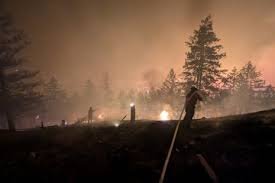
British Columbia Battles Unprecedented Wildfires: Fast-Moving Blazes Trigger Mass Evacuations
British Columbia is currently locked in a desperate struggle against a relentless onslaught of wildfires. With 102 fires raging across the province, emergency crews are working day and night to contain blazes that are spreading with terrifying speed, leaving communities in their wake and forcing thousands to abandon their homes.
The situation has escalated rapidly, with the BC Wildfire Service reporting that nearly half of the active fires are categorized as “out of control.” Of these, a staggering 78 ignited within a single week, highlighting the volatility of the current environment.
A State of Emergency: Communities Under Siege
The human toll of these fires is already devastating. A tragic report from the Royal Canadian Mounted Police (RCMP) confirmed the death of an 80-year-old woman who perished while attempting to flee the flames in the Okanagan Lake region. Furthermore, approximately 22,000 people have been forced into frantic evacuations.
In the community of Summerland, residents describe a scene of pure terror. Anette Boulet, who fled her home at 4:30 AM on Saturday, recalled the haunting sight of the horizon: “You could barely see. It was just dark, and the ridge of fire was just coming towards you.”
Premier David Eby did not mince words when declaring a state of emergency, describing the intensity of the blazes as being “like a bomb going off.”
Federal Intervention and Urgent Relief
Recognizing the scale of the disaster, the Canadian federal government has stepped in. Eleanor Olszewski, Minister of Emergency Management and Community Resilience, has approved a request for urgent federal assistance. This support is primarily focused on providing essential shelter and accommodations for those displaced by the fires.
Public Safety Canada is currently coordinating with provincial officials to ensure that resources reach the most vulnerable populations as the crisis unfolds.
Why Are These Fires So Extreme?
Experts warn that we are witnessing a shift in how wildfires behave. Mike Flannigan, a professor of wildland fire at Thompson Rivers University, points to a dangerous combination of prolonged drought and human-caused climate change.
The “Night-Burning” Phenomenon
Historically, firefighters could rely on cooler nighttime temperatures to slow the spread of fire. However, that is no longer the case. Due to extreme dryness and heat, fires are now “metastasizing” through the night, maintaining their momentum even in the dark. This has forced agencies to deploy night-vision helicopters to continue the fight 24/7.
From “Fire Season” to “Fire Years”
The environmental conditions in Southern BC and the Pacific Northwest are described as “bone dry,” with almost no rain in the past six weeks. Flannigan warns that Canada may be moving away from a seasonal fire cycle toward “fire years,” where blazes persist well into the autumn.
Essential Safety Tips for At-Risk Regions
With fires now capable of traveling up to 60km in a single day, the old safety calculations are obsolete. Experts urge all residents in high-risk areas to be proactive:
- Prepare an Emergency Kit: Include water, non-perishable food, medications, and important documents.
- Stay Informed: Monitor local alerts and the Environment and Climate Change Canada updates.
- Have an Evacuation Plan: Know your primary and secondary exit routes from your neighborhood.
- Act Fast: If an evacuation order is issued, leave immediately. Do not wait until you see flames.
As BC continues to fight these “explosive” conditions, the focus remains on saving lives and protecting the remaining communities from an increasingly unpredictable climate.



