
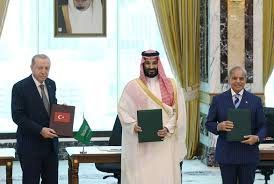
The New Shield: Pakistan and Turkey Join Saudi Arabia in Powerful Defense Alliance
In a seismic shift for Middle Eastern geopolitics, Saudi Arabia has successfully anchored two of the Muslim world’s most formidable military powers—Pakistan and Turkey—into a strategic defense framework. As regional tensions with Iran escalate, this new collective-defense alliance aims to create a deterrent capable of altering the balance of power in the Gulf.
A “NATO-Style” Pact: An Attack on One is an Attack on All
Signed in the holy city of Mecca, this mutual defense agreement is modeled after the NATO framework. The cornerstone of the treaty is a bold commitment: any act of aggression against one of the three member states shall be regarded as an attack on them all.
While the official statement emphasizes the “enhancement of defense cooperation” and “collective deterrence,” the underlying message is clear. Saudi Arabia is diversifying its security portfolio, reducing its historical reliance on the United States amid growing uncertainty regarding Washington’s long-term commitment to its oil-rich allies.
Why Pakistan and Turkey? The Strategic Advantage
The inclusion of Pakistan and Turkey transforms the Saudi security landscape by adding unprecedented military weight:
- n
- Pakistan: As the only nuclear-armed nation in the Muslim world, Pakistan provides a psychological and strategic deterrent that is unmatched in the region.
- Turkey: Boasting the second-largest military force within NATO, Turkey brings immense conventional firepower and tactical expertise to the table.
Together, these three nations present a united Sunni-led military front, creating a powerful counterbalance to the mounting threats posed by Iran and its regional proxies.
The Iranian Factor: Deterrence vs. Tension
Although Turkish and Saudi officials have denied that the pact targets any specific actor, the timing is unmistakable. With Iran-backed militias in Yemen and Iraq continuing to threaten Saudi infrastructure, Riyadh is sending a stark warning to Tehran: any future major assault could trigger a wide-scale conflict involving Pakistan and Turkey.
Tehran has already voiced its dissatisfaction. Iranian officials have dismissed the treaty as a “paper agreement,” arguing that relying on foreign alliances—whether with the US or regional partners—will not guarantee Saudi Arabia’s security.
A Delicate Balancing Act
Despite the strength of the alliance, the path forward is fraught with complexity. Both Turkey and Pakistan share borders with Iran, making them hesitant to be drawn into a full-scale war that could destabilize their own frontiers.
- n
- Pakistan must carefully manage its internal Shiite population and maintain a working relationship with Tehran.
- Turkey shares critical concerns with Iran regarding Kurdish separatism, requiring a nuanced diplomatic approach.
Conclusion: A New Era of Regional Security
The formation of this tripartite alliance marks a turning point in how Middle Eastern powers manage security. By integrating the military might of Turkey and the nuclear prestige of Pakistan, Saudi Arabia is no longer just a client state of the West, but a leader of a new, independent security axis.
As the world watches, the effectiveness of this pact will be tested not by the ink on the paper, but by the reactions of its adversaries in the coming months.



