
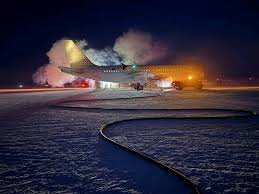
A Battle Against the Elements: The Extraordinary Antarctica Rescue
Imagine a world of absolute darkness, where temperatures plummet to a bone-chilling -43°C (-45.5°F) and the wind howls across a frozen wasteland. This was the reality for an Australian aviation team recently tasked with one of the most dangerous missions in modern polar history: a mid-winter medical evacuation from the heart of Antarctica.
The mission began on July 28, when the Australian Antarctic Division issued an urgent plea for help. A US expeditioner stationed at the McMurdo research station required immediate medical attention, triggering a high-stakes operation that pushed aviation technology to its absolute limits.
The Flight of the ‘Snowbird 1’
The rescue was spearheaded by Skytraders, an airline renowned for its specialized flights to the frozen continent. While an initial attempt was thwarted by severe weather, the team didn’t waver. On July 31, the Airbus A319, aptly named Snowbird 1, took off from Australia in the early hours of the morning.
Landing at McMurdo Station was anything but routine. The crew faced a combination of factors that would make any pilot hesitate:
- n
- Total Darkness: Operating in the pitch-black conditions of the Antarctic winter.
- Extreme Cold: Temperatures dipping to -43°C, threatening aircraft systems.
- Unstable Runways: Landing on compacted snow, which requires precise grooming to ensure enough friction for a safe stop.
Precision Under Pressure
Captain Al Wallach, the lead pilot, described the operation as being “right on the edge” of what specialized aircraft can handle. The margin for error was zero. Co-pilot Louise Robertson highlighted the intense mental workload, noting that the crew had to perform complex cold-weather calculations and altitude corrections in real-time.
“It was a huge amount of concentration and workload, and a lot of mental maths,” Robertson shared, reflecting on the stress of potential worst-case scenarios, such as total power outages at the airstrip.
A Global Effort for a Single Life
After successfully transferring the American patient, the Snowbird 1 departed quickly to avoid deteriorating weather, heading straight for Christchurch, New Zealand. While the patient’s identity remains private, Skytraders has confirmed that the individual is now recovering well.
This mission serves as a powerful reminder of the international cooperation required to maintain a human presence in the most inhospitable place on Earth. From meteorological teams tracking unpredictable patterns to the coordinated efforts of US and Australian agencies, this rescue was a triumph of human skill and bravery.
For those interested in how science is conducted in such extreme environments, the United States Antarctic Program (USAP) provides fascinating insights into the challenges of living and working at McMurdo Station.



