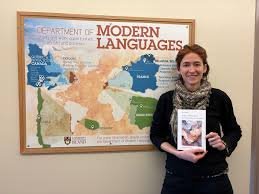
UPEI Professor Explores the ‘Abject Sublime’ in New Book on Transcreation
Dr. Marie Pascal, an assistant professor in the University of Prince Edward Island (UPEI) Department of Modern Languages, has released a compelling new book titled L’abject sublime dans la transcréation au Canada. This groundbreaking work, written in French, marks the first volume of a two-part exploration into the concept of the “abject sublime.”
Understanding the Abject Sublime & Transcreation
The “abject sublime” is a unique aesthetic experience where seemingly opposing emotions – horror, disgust, and revulsion (the abject) – blend with feelings of awe, majesty, and transcendence (the sublime). Dr. Pascal’s research delves into how this complex interplay manifests in creative adaptations.
Central to her work is the concept of transcreation, a process distinct from traditional translation or adaptation. Transcreation involves creatively reimagining content from one medium to another – for example, from a novel to a film – while meticulously preserving its core intent, tone, and meaning. It’s about recreating the *feeling* of the original, not just the words.
A Deep Dive into Canadian Literature and Film
For this first volume, Dr. Pascal meticulously analyzed fifteen Québecois, English Canadian, and Indigenous books, alongside their corresponding film adaptations. Her goal was to understand how language and content evolve and complement each other throughout the transcreation process. She purposefully selected works spanning a diverse range of genres, including horror, realism, science fiction, autofiction, poetry, and ecofiction, to provide a comprehensive overview.
As the publisher’s summary eloquently states (translated from French), “While it goes without saying that films and novels transport us to unexpected worlds, featuring unsettling characters and sometimes unacceptable endings, it’s harder to understand why we willingly seek out fear, tears, or indignation within them. Could it be that the terror and disgust we feel are a way of proving that we are indeed alive? Through the spectacle of the abject sublime, these works provoke a powerful emotion, which our initial reflex is to suppress. Yet, these representations, which lure us with their imagined stories, often do so with the aim of shaking us up, providing an aesthetic shock that compels us to emerge from apathy. And the resulting emotions linger within us, sometimes despite ourselves.”
The study features insightful analyses of notable Canadian works such as Xavier Dolan’s The Night Laurier Gaudreault Woke Up, David Cronenberg’s Crash!, and Naomi Fontaine’s Kuessipan.
What’s Next? Volume Two
The second volume, slated for release early next year, will continue this exploration with a focus on Richard Wagamese’s Indian Horse (and its adaptation), Yann Martel’s Life of Pi, Margaret Atwood’s The Handmaid’s Tale and The Testaments, the filmography of Denis Villeneuve, and David Cronenberg’s signature “body horror” genre. Both volumes are published by Les Presses de l’Université de Montréal.
Dr. Pascal’s Contributions to UPEI
Dr. Pascal joined UPEI’s Department of Modern Languages in 2024. Beyond her teaching responsibilities, she also directs Transcr(é)ation, a journal she founded in 2022. Her previous publication, De l’exclusion à l’abjection, was released by Les Presses de l’Université de Montréal in 2023.
Dr. Pascal gratefully acknowledges the support of Dr. Sharon Myers, Dean of Arts, and her colleagues Dr. Scott Lee and Dr. Sanda Badescu, as well as UPEI’s internal research grant program.
UPEI Research Support
UPEI recognizes the vital role of research funding and acknowledges the support of Canada’s tri-council of federal granting agencies – the Natural Sciences and Engineering Research Council of Canada (NSERC), the Social Sciences and Humanities Research Council (SSHRC), and the Canadian Institutes of Health Research (CIHR) – through its Research Support Fund. In 2025–2026, UPEI’s RSF allocation is $1,168,176.